


Coding regions together
Simultaneously evaluates captured exons of known genes and areas close to splice junctions, according to coverage and technical scope.
Nuclear exome + mitochondrial genome
In a single test, NeoExoma evaluates the most informative parts of thousands of genes and also mitochondrial DNA. It is an option for investigating hereditary diseases when it is necessary to analyze many genes at once, with interpretation guided by clinical signs and family history.

What the test adds
The exome is useful when the hypothesis involves a monogenic disease, but signals may be associated with many genes and a restricted panel may not be sufficient.
Simultaneously evaluates captured exons of known genes and areas close to splice junctions, according to coverage and technical scope.
Mitochondrial DNA is analyzed in the same assay, respecting coverage limits, type of variant, tissue and heteroplasmy.
Symptoms, age of onset, tests, family history and clinical hypothesis help to select the most relevant findings.
Clinical indication
The indication must consider the phenotype, family history, previous tests and the types of variant that need to be investigated.
01
Intellectual disability, global delay, regression or multiple neurological findings.
02
One or more anomalies, dysmorphisms or multisystem changes without a defined cause.
03
Combination of signs that do not clearly point to a syndrome or small group of genes.
04
When clinical evaluation justifies expanding the search to other coding genes.
Scope and limits
A negative result does not exclude a genetic condition. The cause may be outside the captured regions, in a variant class not well evaluated by the method, or may not yet be known.
NeoExoma investigates
May require another test
Test choice
The exome focuses the analysis on coding regions. The genome offers greater sensitivity to a broader spectrum of genetic changes from the beginning of research.
NeoExoma
Analyzes SNVs, indels, CNVs above three exons and mitochondrial DNA in thousands of genes.
NeoGenoma
It is the preferred strategy when a more comprehensive genetic analysis is required, with greater sensitivity for a broader group of alterations, including smaller CNVs, small structural variants and regions beyond the exome.
Follow-up after your results
All NeoGenomica tests include Infinity VUS to follow reported variants of uncertain significance. When a relevant reclassification is confirmed after specialist review, the doctor is notified and the report may be updated.
Understand results and Infinity VUSTesting process
An organized clinical journey to investigate the coding regions and mitochondrial genome.
Phenotype, family history and previous tests guide the analysis.
The team informs you of the material, documentation and shipping conditions.
The nuclear exome and co-captured mitochondrial genome are processed with quality control.
Variants are prioritized as appropriate and reviewed by the specialized team.
The result organizes the findings and includes the Infinity VUS for the reported variants.
Clinical interpretation
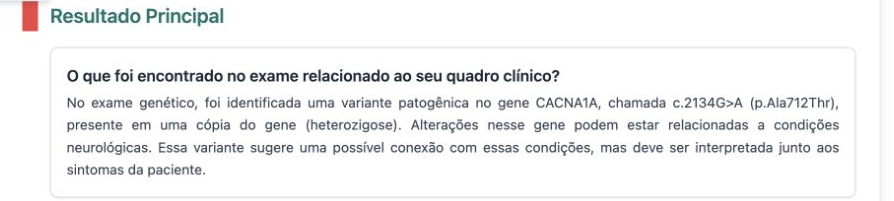
The report highlights the finding related to the condition, describes the variant and presents its interpretation to support the discussion with the requesting physician.
Real excerpt from the NeoReport demonstration environment, cut without personal data.
Frequently asked questions
A panel evaluates a previously defined set of genes. The exome searches the coding regions of thousands of genes and can be useful when the picture is heterogeneous or the hypothesis is not restricted to a few genes.
Yes. The assay includes co-capture and analysis of the mitochondrial genome. Sensitivity depends on coverage, variant, tissue and heteroplasmy; some hypotheses may require additional investigation.
No. The cause may be out of scope, in a region with insufficient coverage, in another type of variant, or not yet known. The doctor may recommend reanalysis or another method.
When more comprehensive genetic investigation is required, NeoGenoma is the preferred strategy. It offers greater sensitivity to a broader group of alterations, including smaller CNVs, small structural variants, and regions beyond the exome.
Yes. The request and clinical information guide the prioritization and interpretation of findings.
Decision support
Our team advises on scope, sampling, documentation, and alternatives when genomics may be more appropriate.
Test information
Whole exome with mitochondrial genome co-capture and clinical interpretation.
Medical request, phenotype, family history and previous tests to guide prioritization and interpretation.
It does not primarily target deep intronic, promoter or regulatory regions. Repeats, rearrangements, methylation, high homology, and low coverage may require another method.
A negative result does not exclude a genetic condition. Mitochondrial sensitivity varies depending on tissue, coverage, variant and heteroplasmy. Infinity VUS included.

