


Precision in details
Contributes to the detection of SNVs, small indels and depth signals used in the evaluation of deletions and duplications.
Hybrid genomic sequencing
Combines short and long reads to investigate structural variants, repeats and complex regions. It can be ordered from the start or added to NeoGenoma, depending on the case.
Flexible ordering
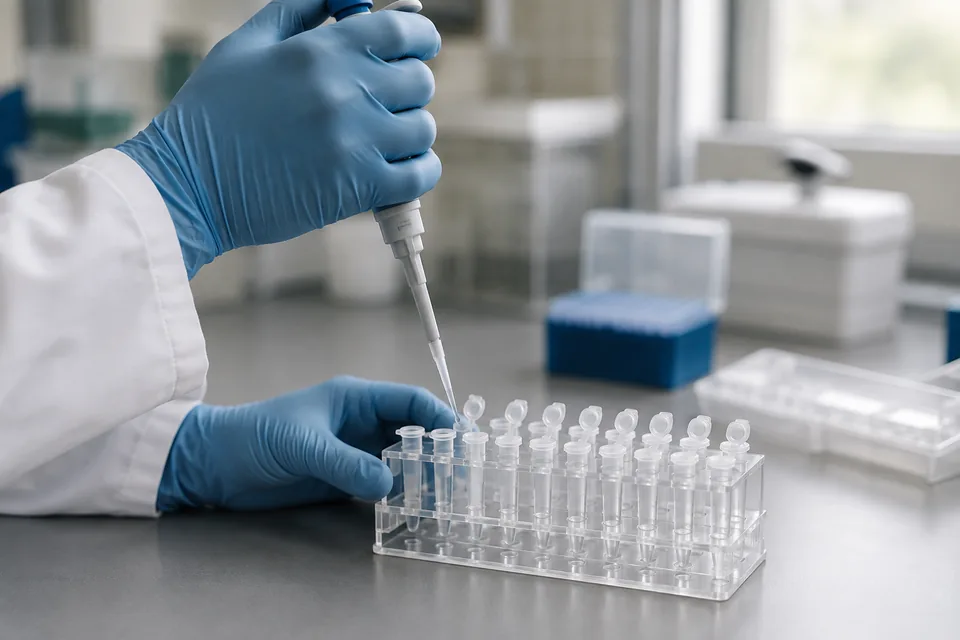
The investigation can start with NeoGenoma. If the result does not resolve the case, the team can evaluate the long-read add-on to form the hybrid analysis.
Perform whole-genome sequencing with short reads first and evaluate long-read complement as per clinical need.
Get to know NeoGenomaIf the case remains undiagnosed, the team can add the additional long-read sequencing step without repeating the short-read sequencing. The new evidence is integrated with the NeoGenoma data.
Request the add-onSample Eligibility: the subsequent complement depends on the quantity, quality and storage conditions of the original sample. The team confirms technical feasibility before ordering; a new sample collection may be necessary.
How it works
Short reads provide depth and base accuracy. Long reads span repetitive regions and help reconstruct the context of complex regions. Pipeline Hybrid NeoGenomica integrates both sources of evidence in a single analysis.
Contributes to the detection of SNVs, small indels and depth signals used in the evaluation of deletions and duplications.
It traverses repeats, pseudogenes and breakpoints, expanding the resolution of complex insertions and rearrangements.
The evidence is processed together and related to the phenotype, without generating a sequence of independent reports.
What long reads add
The gain depends on the region, the type of change, the quality of the sample and the validated scope of each module.
01
Inversions, translocations, large deletions, duplications, insertions and complex rearrangements.
02
Repetitive regions that short reads alone may not size or map accurately.
03
Loci such as PMS2, SMN1/SMN2, CYP21A2 and GBA, in which the origin of the sequence may be ambiguous.
04
5mC signals in selected clinical regions and relationship between variants on the same haplotype.
Clinical indication
Especially when a difficult region, a repeat, a rearrangement or a previous inconclusive result supports the need to expand the investigation.
Neurology
Conditions with progressive ataxia, neuropathy, vestibulopathy or suspected recurrent expansion.
Neuromuscular
Situations where repeat size, haplotype and methylation may be relevant.
Endocrinology
Investigation of CYP21A2, gene conversions and rearrangements of the RCCX locus.
Difficult genes
When short reads can map to more than one locus and make classification difficult.
Clinical genetics
Complex cases in which CNVs, insertions, inversions or translocations can explain the phenotype.
Cancer genetics
Families with strong clinical suspicion and inconclusive tests, according to specialized assessment.
Internal technical validation
The pipeline was compared on the GIAB HG002 sample with official truth sets. The results below describe this benchmark and do not equate to clinical sensitivity in all cases.
21% → 74%
Detection in the short read benchmark versus hybrid analysis.
13% → 72%
Gain observed mainly on longer insertions.
≈29% → 88%
Structural variants in regions of the GIAB CMRG set.
>99%
Accuracy observed for small variants in the evaluated set.
GIAB HG002 sample; truth sets of v5.0q structural variants, v4.2.1 small variants, and CMRG regions. Internal technical validation NeoGenomica.
Integrated scope
The pipeline integrates SNVs, indels, CNVs, insertions, structural variants, repeats, regions of high homology and selected methylation modules, according to technical criteria.
Technical transparency
NeoGenoma Omni is not intended for the investigation of somatic mosaicism at low allelic fraction. When this is the main clinical suspicion, the NeoExoma Mosaico offers high depth and confirmation of relevant candidates within the technical criteria. In CNVs and structural variants, there may be uncertainty in the delimitation of coordinates.
Follow-up after your results
All NeoGenomica tests include Infinity VUS to follow reported variants of uncertain significance. When a relevant reclassification is confirmed after specialist review, the doctor is notified and the report may be updated.
Understand results and Infinity VUSTesting process
A single flow to combine short reads, long reads, and clinical context.
The diagnostic hypothesis, phenotype and previous tests guide the analysis modules.
Blood or mouth swab, depending on the technical requirements of the case.
The same sample is processed with short reads and long reads.
The evidence is integrated and reviewed by the specialized team.
The result relates the findings to the clinical context and includes Infinity VUS.
Frequently asked questions
The two analyze the genome. Omni adds long reads to increase the resolution of insertions, structural variants, repeats, selected methylation, and regions of high homology.
No. It is possible to start with NeoGenoma and request the long read add-on if the case remains undiagnosed, without repeating the short read step. Reusing the original sample depends on technical evaluation and a new sample collection may be necessary.
Mosaicism at low allelic fraction is beyond the scope of this methodology. For this hypothesis, consider the NeoExoma Mosaico.
Blood or a buccal swab, according to the technical requirements and the team’s guidance. The same sample is used to generate both types of reads.
Yes. Clinical hypothesis and previous tests are essential to select modules, prioritize variants and interpret results.
Complex cases
Our team helps match the phenotype, previous testing, and suspected variant class to the best analysis design.
Test information
Additional reads for difficult regions, available from the beginning or as a second step after NeoGenoma.
Medical request with diagnostic hypothesis, phenotype and previous tests. The subsequent complement depends on the quantity, quality and storage of the original sample.
Mosaicism at low allelic fraction is beyond the scope of this methodology. The gain depends on the region, the type of change, the quality of the sample and the validated scope of each module.
Subsequent reuse of the sample depends on technical evaluation; a new sample collection may be necessary. Infinity VUS included.

