


Beyond the exome
Includes clinically relevant coding and non-coding regions, respecting the technical and quality limits of the test.
WGS Whole-genome sequencing
Analysis of nuclear and mitochondrial DNA guided by the clinical presentation, including regions beyond the exome. Results can support the investigation, without guaranteeing that a cause will be found.
Compare test strategies
Clinical scope
The value is not just in the volume of data, but in the possibility of bringing together signals from different regions and scales in a case-driven analysis.
Includes clinically relevant coding and non-coding regions, respecting the technical and quality limits of the test.
The analysis includes sequence variants, copy number changes, structural variants and mitochondrial DNA.
The broad dataset can support future reanalyses, while reported VUS remain tracked by Infinity VUS.
Clinical indication
A choice to initiate or expand the investigation when the objective is to evaluate as many hypotheses as possible in a single examination.
When the clinical question asks for a comprehensive view, without limiting the analysis to coding regions only.
When panels, exome or previous evaluations did not explain the clinical picture.
Multisystemic conditions, atypical presentations, or broad genetic hypotheses.
When structural, deep intronic, regulatory or mitochondrial variants may be relevant.
Test choice
The strategy must accompany the clinical question. NeoGenoma offers the broadest scope; Exomes and panels can be chosen when the investigation is more limited.
| Feature | NeoGenoma | Exome | Dashboard |
|---|---|---|---|
| Scope | Whole genome* | Coding regions | Selected genes |
| Genes analyzed | ≈ 22.000 | ≈ 22.000 | According to the panel |
| Changes investigated | SNVs, indels, CNVs > 1 exon, mitochondrial DNA, intronic and regulatory regions; some expansions | SNVs, indels, CNVs > 3 exons and mitochondrial DNA | According to the panel and methodology |
| Reanalysis | Wide | Restricted to the exome | Restricted to captured genes |
* Coverage note: “Full genome” describes the intended scope of the scan, not a guarantee of reading every base. Repetitive regions, regions of high homology, or regions with insufficient coverage or quality may not be adequately sequenced or analyzed.
Follow-up after your results
All NeoGenomica tests include Infinity VUS to follow reported variants of uncertain significance. When a relevant reclassification is confirmed after specialist review, the doctor is notified and the report may be updated.
Understand results and Infinity VUSTesting process
A structured flow to preserve sample quality, incorporate clinical data and support result interpretation.
The diagnostic hypothesis and phenotypic data guide the analysis strategy.
Blood or a buccal swab, according to the team’s guidance and the case requirements.
Sequencing, bioinformatics processing and specialized review of findings.
Report with clinical interpretation and follow-up of reported VUS.
Clinical interpretation
The findings are organized in relation to the diagnostic hypothesis, with evidence, classification and technical limits.
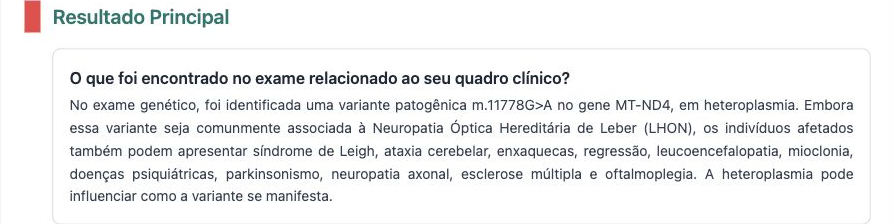
Real excerpt from the NeoReport demonstration environment, cut without personal data.
Frequently asked questions
The exome is mainly concentrated in coding regions. The genome extends the investigation to non-coding regions and offers a more uniform data set for different classes of variants.
No. The term describes the intended scope. Repetitive regions, regions of high homology, or regions with insufficient coverage or quality may not be adequately sequenced or analyzed.
The analysis includes sequence variants, copy number changes, structural variants and mitochondrial DNA, in addition to clinically relevant non-coding regions, according to the technical criteria of the test.
Yes. The request and clinical information are essential to guide the analysis and relate findings to the patient's phenotype.
The sample can be blood or a mouth swab. The team guides the most appropriate material, preparation, sample collection and sending according to the context of the case.
20 calendar days, after receipt of complete documentation .
A result without a conclusive finding does not necessarily end the investigation. The data can be reassessed as new genes, variants and evidence become known. The long-read add-on can also be ordered on its own to extend the test to the scope of NeoGenoma Omni, subject to the technical suitability of the stored sample.
Next step
Our team guides the request and gathers the clinical information that qualifies the analysis.
Test information
Broad investigation of the nuclear and mitochondrial genome, guided by the clinical picture.
Medical request, diagnostic hypothesis, phenotypic data, family history, accepted sample and necessary clinical information.
Repetitive regions, regions of high homology, or regions with insufficient coverage or quality may not be adequately sequenced or analyzed.
“Full genome” describes the intended scope of the examination and does not guarantee reading of every base. Infinity VUS included for reported variants.

