Logo NeoGenomica

Reproductive genetic screening

Know first. Plan clearly.

O NeoPainel Plus Carrier analyzes 1,059 genes associated with hereditary conditions and includes additional analyzes for Fragile X Syndrome and SMN1. O Duo carries out the same investigation on both partners and compares the results.

Couple talking at home about planning for the future
Complete genome, dedicated analysis and reproductive interpretation.
Test basis
PCR-free complete genome
Coverage
Minimum average of 30x
Additional analysis
X-Fragile and SMN1
Modalities
Individual or Duo

Information before pregnancy

Reproductive risk transformed into informed decision.

Screening looks for pathogenic or likely pathogenic variants associated primarily with autosomal recessive and X-linked conditions. The result can guide genetic counseling, partner assessment and individualized discussion of reproductive possibilities.

Modalities

NeoPainel Plus or Duo: choose according to your needs.

Plus for individual analysis. Duo for the couple, with examination of each partner and integrated comparison of results.

Individual test

NeoPainel Plus Carrier

Recommended for those who want to know their carrier status before or during reproductive planning.

  • Expanded mask with 1,059 genes.
  • Additional analyzes for Fragile-X Syndrome and SMN1.
  • Report with interpretation of the carrier status.
  • Relevant findings can guide partner screening.
See what's analyzed

Examination for the couple

Plus Duo Carrier NeoPainel

Performs the Plus protocol for each partner and adds an integrated reading of reproductive genetic compatibility.

Two partners

Individual tests with joint analysis of genetic compatibility.

  • Plus Protocol carried out for both partners.
  • Identification of genes with relevant findings in the couple.
  • Assessment of combined risk according to the inheritance pattern.
  • Targeted recommendation for genetic counseling.
Understand the Duo result

Combined technology

Dedicated analyzes where the genome needs strengthening.

The protocol combines whole-genome sequencing with region-specific strategies that require specialized methods and interpretation.

Test basis

PCR-free complete genome

Second generation sequencing, minimum average coverage of 30x and at least 95% of bases above 15x. The analysis includes point variants, CNVs and structural variants.

Additional Analysis

Fragile-X Syndrome

A dedicated test evaluates CGG repeat expansions by PCR and capillary electrophoresis, differentiating normal, intermediate, pre-mutation and complete mutation ranges.

Additional Analysis

SMN1 and Spinal Muscular Atrophy

The number of copies of SMN1 is estimated by a specific pipeline, with analysis of exons 7 and 8 and consolidation of tools to identify the carrier state.

Mask content

1,059 genes selected for reproductive relevance.

The scope brings together recessive and X-linked conditions from different systems, focusing on findings that can modify the individual or couple's counseling.

Respiratory and metabolic

CFTR, PAH, GALT, ACADM, GAA and others.

Hematological

HBA1, HBA2, HBB, G6PD, F8 and others.

Neuromuscular

SMN1, DMD, NEB, DYSF, RYR1 and others.

Hearing and vision

GJB2, GJB6, USH2A, ABCA4, RPE65 and others.

Lysosomal

GBA1, HEXA, IDUA, GALC, SMPD1 and others.

Renal and multisystem

PKHD1, COL4A3, COL4A4, COL4A5 and others.

Fragile-X Syndrome

Additional test dedicated to investigating CGG repeat expansions.

SMN1

Additional copy number assessment for Spinal Muscular Atrophy carrier screening.

The relationship of genes and the availability of additional analyzes must be confirmed in the request. The report presents the genes actually evaluated in each sample.

Genetic compatibility of the couple

What the NeoPainel Duo delivers.

The test analyzes each partner and compares the results gene by gene, respecting the inheritance pattern of each condition.

01 · Same recessive gene

Shared risk

When both carry relevant variants in the same autosomal recessive gene, each pregnancy can have a 25% dhance of an affected child.

25%
affected
25%
carrier
25%
carrier
25%
non-carrier
02 · Different genes

Different individual results

A couple may have findings in different genes without an increased combined risk for the same condition. Each result must still be interpreted individually.

03 · No shared find

Residual risk remains

The result reduces the risk for the included conditions, but does not eliminate it. Technical limitations and still unknown mechanisms need to be contextualized.

The 25% proportion is typical for relevant variants in the same gene as an autosomal recessive condition. X-linked conditions and other patterns require specific calculations.

Test day

From sampling to reproductive planning.

An organized flow for individual or Duo modality, with interpretation of residual risk.

  1. 01

    Request

    Definition of the individual or Duo modality and pre-test guidance.

  2. 02

    sample collection

    Sample receipt and laboratory quality controls.

  3. 03

    Analysis

    Complete genome, 1,059 gene mask and additional protocols.

  4. 04

    Interpretation

    Individual report and couple compatibility analysis in Duo mode.

Reproductive planning

Carrier status explained clearly.

The report informs the variants identified, the genes involved and what the result means for the person evaluated and for family planning.

  • Top result in accessible language
  • Genes and conditions associated with the findings
  • Partner assessment guidance when applicable

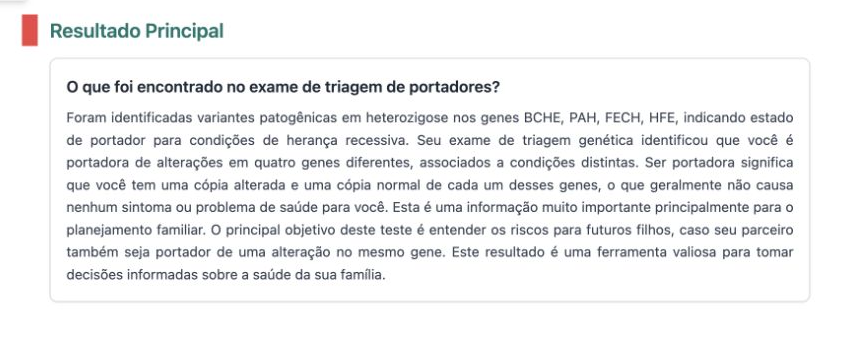
Real excerpt from the NeoReport demonstration environment, cut without personal data.

Anonymized excerpt from a report demonstrating Carrier's NeoPainel with main result
Demonstrative and anonymized example. The content and length of the report vary depending on the findings of each test.

Frequently asked questions

Before deciding, understand the essentials.

Genetic counseling helps to contextualize indications, limitations and next steps.

Who is the Bearer NeoPainel suitable for?+

For people and couples who want to know about reproductive genetic risks, including before pregnancy, in assisted reproduction or when there is a relevant family history. The final indication must be individualized.

What is the practical difference between Plus and Duo?+

Plus describes a person's carrier status. Duo screens both partners and adds joint analysis to identify shared reproductive risks.

Are X-Fragile and SMN1 part of the protocol?+

They are highlighted as additional analyzes because they require specific strategies: CGG repeats for Fragile X Syndrome and copy number for SMN1. Availability must be confirmed when ordering.

Does a negative result eliminate all risk?+

No. The result reduces the probability for the conditions and variants evaluated, but does not exclude changes outside the mask, regions that are difficult to analyze or mechanisms that are still unknown.

Is the 25% visk valid for any couple finding?+

No. This proportion is typical when both are carriers of the same gene for an autosomal recessive condition. Other inheritance patterns require specific calculations and advice.

Reproductive planning

Planning a family can also start with DNA.

Talk to the team to understand which modality makes sense for you or the couple.

This content is informative and does not replace medical evaluation or genetic counseling. The panel composition, technical limitations and clinical interpretation must be confirmed in the order and report.

Catalog information

Technical data of NeoPainel Plus Carrier

Screening for recessive conditions for a person, with assessment of carrier status.

Applications
Reproductive planning
Accepted samples
peripheral blood, Mouth swab, DNA extraído
Estimated deadline
30 calendar days, contados após sample acceptance.
FAST · 15 calendar days, contados após sample acceptance.
Base method
Second generation PCR-free complete genome, minimum average coverage of 30x, mask of 1,059 genes and dedicated tests for Fragile X and SMN1.
Analytical scope
Point variants, CNVs, structural variants, CGG expansion of FMR1 and copy number of exons 7 and 8 of SMN1.
Genes analyzed
1059 genes registered in the structured scope of the test.
See full content

AAAS, ABCA12, ABCA3, ABCB11, ABCB4, ABCC6, ABCC8, ABCD1, ABCD3, ABCD4, ABCG5, ABCG8, ACAD8, ACAD9, ACADM, ACADS, ACADSB, ACADVL, ACAT1, ACTA2, ACTC1, ACVRL1, ACOX1, ACOX2, ACSF3, ACY1, ADA, ADAMTS13, ADAMTS2, ADGRG1, ADGRV1, ADK, AGA, AGL, AGPAT2, AGPS, AGRN, AGXT, AHCY, AHI1, AICDA, AIPL1, AIRE, AK2, AKR1D1, AKT2, ALAD, ALAS2, ALDH3A2, ALDH4A1, ALDH5A1, ALDH6A1, ALDH7A1, ALDOA, ALDOB, ALG1, ALG14, ALG2, ALG6, ALMS1, ALOX12B, ALOXE3, ALPL, AMACR, AMN, AMPD2, AMT, ANO10, ANTXR2, AP3B1, APOA5, APOB, APOC2, APC, APRT, AQP2, ARG1, ARL13B, ARL6, ARPC1B, ARSA, ARSB, ARX, ASCC3, ASL, ASNS, ASPA, ASS1, ATM, ATP13A2, ATP6V0A4, ATP6V0A2, ATP6V1B1, ATP6V1E1, ATP7A, ATP7B, ATP8B1, ATRX, AUH, AVPR2, B2M, B9D1, B9D2, BAG3, BAAT, BBS1, BBS10, BBS12, BBS2, BBS4, BBS5, BBS7, BBS9, BCHE, BCKDHA, BCKDHB, BCKDK, BCL10, BCS1L, BLM, BLNK, BLOC1S3, BLOC1S6, BMP1, BMPR1A, BRCA1, BRCA2, BRIP1, BSND, BTD, BTK, C19orf12, C3, CA5A, CACNA1S, CAD, CALM1, CALM2, CALM3, CAPN3, CARD11, CARMIL2, CASP8, CASQ2, CASR, CAV3, CAVIN1, CBLIF, CBS, CC2D2A, CCDC8, CCDC88C, CCN6, CD247, CD27, CD320, CD3D, CD3E, CD3G, CD40, CD40LG, CD70, CD79A, CD79B, CD8A, CDCA7, CDCA8, CDH23, CEP104, CEP290, CERKL, CERS3, CFP, CFTR, CHAT, CHD8, CHMP1A, CHRNA1, CHRNB1, CHRND, CHRNE, CHRNG, CHST6, CIB2, CIITA, CLCF1, CLCN1, CLCN5, CLCN7, CLCNKA, CLCNKB, CLDN16, CLDN19, CLN3, CLN5, CLN6, CLN8, CLP1, CLPB, CLRN1, CNGA1, CNGB1, CNGB3, CNNM2, CNTNAP2, COASY, COL13A1, COL1A1, COL1A2, COL3A1, COL4A3, COL4A4, COL4A5, COL7A1, COLQ, COQ2, COQ4, COQ5, COQ6, COQ7, COQ8A, COQ8B, COQ9, CORO1A, CP, CPLANE1, CPOX, CPS1, CPT1A, CPT2, CRLF1, CRTAP, CSF3R, CTC1, CTLA4, CTNS, CTPS1, CTSA, CTSD, CTSF, CTSK, CUBN, CUL7, CWC27, CXCR2, CXCR4, CYB5A, CYB5R3, CYBA, CYBB, CYBC1, CYP11A1, CYP11B1, CYP11B2, CYP17A1, CYP1B1, CYP21A2, CYP27A1, CYP27B1, CYP2R1, CYP4F22, CYP7B1, D2HGDH, DBT, DCAF17, DCLRE1C, DDB2, DDC, DES, DGAT1, DHCR7, DHDDS, DHFR, DLAT, DLD, DMD, DMP1, DNAJC12, DNAJC19, DNAJC21, DNMT3B, DOCK2, DOCK8, DOK7, DPAGT1, DPYD, DPYS, DSP, DTNBP1, DUOX2, DUOXA2, DYNC2H1, DYSF, ECHS1, EDA, EFEMP2, EFL1, EIF2B1, EIF2B2, EIF2B3, EIF2B4, EIF2B5, EIF6, ELANE, ELP1, EMD, ENG, ENPP1, EPO, ERCC2, ERCC3, ERCC4, ERCC5, ERCC6, ERCC6L2, ERCC8, ESCO2, ETFA, ETFB, ETFDH, ETHE1, EVC2, EXOSC3, EYS, F13A1, F13B, F2, F8, F9, FA2H, FAAP24, FAH, FAM161A, FANCA, FANCB, FANCC, FANCD2, FANCE, FANCF, FANCG, FANCI, FANCL, FAS, FASLG, FBN1, FBP1, FBXL4, FECH, FERMT3, FGA, FGF23, FGFR3, FH, FHL1, FKBP10, FKRP, FKTN, FLAD1, FLNC, FMO3, FMR1, FOLR1, FOXA2, FOXE1, FOXN1, FOXP3, FOXRED1, FRAS1, FREM2, FUCA1, FXYD2, G6PC1, G6PC3, G6PD, GAA, GALC, GALE, GALK1, GALM, GALNS, GALT, GAMT, GATA1, GATA2, GATM, GBA1, GBE1, GCDH, GCH1, GCK, GCSH, GFI1, GFM1, GFPT1, GGCX, GH1, GHR, GHRHR, GJB2, GJB6, GLA, GLB1, GLDC, GLE1, GLI2, GLIS3, GLRA1, GLRB, GLUD1, GNE, GNPAT, GNPTAB, GNPTG, GNS, GOT2, GPHN, GPIHBP1, GRHPR, GRIP1, GSS, GUSB, GYG1, GYS1, GYS2, HADH, HADHA, HADHB, HAMP, HAVCR2, HAX1, HBA1, HBA2, HBB, HCFC1, HEATR3, HELLS, HEXA, HEXB, HFE, HGSNAT, HIBCH, HINT1, HJV, HK1, HLCS, HMBS, HMGCL, HMGCS2, HNF1A, HNF4A, HOGA1, HPD, HPRT1, HPS1, HPS3, HPS4, HPS5, HPS6, HSD17B10, HSD17B4, HSD3B2, HSD3B7, HYAL1, HYCC1, HYLS1, HYOU1, IDH2, IDS, IDUA, IFNG, IFNGR1, IFNGR2, IFT140, IGHM, IGLL1, IGSF1, IKBKB, IL12B, IL12RB1, IL12RB2, IL18BP, IL23R, IL2RA, IL2RB, IL2RG, IL7R, IMPDH2, INO80, INPP5E, INS, INSR, IRAK1, IRAK4, IRF4, IRF8, IRS4, ITGB2, ITK, ITPA, ITPKB, IVD, IYD, JAGN1, JAK1, JAK3, KCNH2, KCNJ1, KCNJ11, KCNQ1, KCNQ2, KCNT1, KCTD7, KIF14, L1CAM, L2HGDH, LAMA2, LAMA3, LAMA5, LAMB2, LAMB3, LAMC2, LAMP2, LARS1, LAT, LCA5, LCK, LCP2, LCT, LDHA, LDLR, LDLRAP1, LEP, LHX3, LHX4, LIAS, LIFR, LIG4, LIPA, LIPN, LMNA, LMBRD1, LMF1, LOXHD1, LPL, LRAT, LRP2, LRP4, LRPPRC, LTBP4, LYN, LYST, MAGED2, MAGT1, MAK, MALT1, MAML2, MAMLD1, MAN2B1, MANBA, MAP3K14, MAT1A, MAX, MC2R, MCCC1, MCCC2, MCEE, MCOLN1, MCPH1, MED17, MEFV, MEN1, MESP2, MFSD8, MID1, MKKS, MKS1, MLC1, MLH1, MLYCD, MMAA, MMAB, MMACHC, MMADHC, MMUT, MOCS1, MOCS2, MPI, MPL, MPV17, MRAP, MSH2, MSH6, MTHFD1, MTHFR, MTM1, MTR, MTRR, MTTP, MUTYH, MVK, MYBPC3, MYD88, MYH11, MYH7, MYH9, MYL2, MYL3, MYO5B, MYO7A, MYO9A, MYSM1, NADK2, NAGA, NAGLU, NAGS, NBAS, NBN, NCF2, NCF4, NDUFAF2, NDUFAF5, NDUFS4, NDUFS6, NDUFS7, NDUFV1, NEB, NEU1, NEUROG3, NF2, NFKB1, NGLY1, NHEJ1, NIPAL4, NKX2-1, NKX2-5, NNT, NONO, NPC1, NPC2, NPHP1, NPHP3, NPHS1, NPHS2, NR0B1, NR1H4, NR5A1, NTN1, NTRK1, OAT, OBSL1, OCA2, OCRL, OPA3, ORAI1, OSTM1, OTC, OTOF, OTX2, OXCT1, P3H1, PAH, PALB2, PANK2, PAX1, PAX8, PC, PCBD1, PCCA, PCCB, PCDH15, PCK1, PCSK1, PCSK9, PDHA1, PDHB, PDHX, PDP1, PDSS1, PDSS2, PDX1, PDXK, PEX1, PEX10, PEX11B, PEX12, PEX13, PEX14, PEX16, PEX19, PEX2, PEX26, PEX3, PEX5, PEX6, PEX7, PFKM, PGAM2, PGM1, PGM3, PHEX, PHGDH, PHKA1, PHKA2, PHKB, PHKG2, PHYH, PIK3CD, PIK3R1, PKHD1, PKLR, PKP2, PLA2G6, PLAGL1, PLEC, PLEKHG5, PLN, PLOD2, PLP1, PLPBP, PMM2, PMS2, PNP, PNPLA1, PNPO, POLD1, POLD2, POLG, POLH, POMC, POMGNT1, POMT1, POMT2, POR, POU1F1, POU2AF1, POU3F4, PPIB, PPM1K, PPOX, PPT1, PRCD, PRDM5, PREPL, PRF1, PRKAG2, PRKCD, PRKDC, PRODH, PROP1, PSAP, PSAT1, PSPH, PTEN, PTF1A, PTPRC, PTS, PURA, PUS1, PYCR1, PYGL, PYGM, QDPR, RAB23, RAB27A, RAC2, RAG1, RAG2, RAPSN, RARS2, RASGRP1, RB1, RBCK1, RC3H1, RD3, RDH12, RBM20, RET, RFX5, RFXANK, RFXAP, RHOG, RLBP1, RMRP, RNASEH2A, RNASEH2B, RNASEH2C, ROBO1, RORC, RP2, RPE65, RPGR, RPGRIP1, RPGRIP1L, RPH3A, RPL10, RPL10A, RPL11, RPL15, RPL18, RPL19, RPL26, RPL27, RPL3, RPL31, RPL34, RPL35, RPL35A, RPL5, RPL8, RPLP0, RPS10, RPS11, RPS15A, RPS17, RPS19, RPS20, RPS24, RPS26, RPS27, RPS28, RPS29, RPS6KA3, RPS7, RS1, RYR1, RYR2, SACS, SAMHD1, SASH3, SBDS, SCN4A, SCN5A, SCNN1A, SCNN1B, SCNN1G, SCO2, SDCCAG8, SDHAF2, SDHB, SDHC, SDHD, SDR9C7, SELENON, SEMA7A, SEPSECS, SERAC1, SERPINA7, SERPINF1, SGCA, SGCB, SGCD, SGCG, SGSH, SH2D1A, SH3KBP1, SI, SKIC2, SKIC3, SLC12A1, SLC12A3, SLC12A6, SLC16A1, SLC16A2, SLC17A5, SLC18A2, SLC18A3, SLC19A1, SLC19A2, SLC19A3, SLC22A5, SLC25A1, SLC25A13, SLC25A15, SLC25A19, SLC25A20, SLC25A32, SLC25A36, SLC26A2, SLC26A3, SLC26A4, SLC26A7, SLC27A4, SLC2A1, SLC2A10, SLC2A2, SLC30A10, SLC31A1, SLC34A3, SLC35A2, SLC35A3, SLC37A4, SLC39A4, SLC39A7, SLC39A8, SLC3A1, SLC46A1, SLC4A11, SLC51A, SLC52A1, SLC52A2, SLC52A3, SLC5A1, SLC5A5, SLC5A6, SLC5A7, SLC6A19, SLC6A5, SLC6A6, SLC6A8, SLC6A9, SLC7A7, SLC7A9, SMAD3, SMAD4, SMARCAL1, SMN1, SMPD1, SNAP25, SORD, SOX3, SP110, SPATA7, SPG11, SPG21, SPI1, SPPL2A, SPR, SRP54, SRP72, STAR, STAT1, STK11, STK4, STX11, STXBP2, SUCLA2, SUCLG1, SUGCT, SUMF1, SUOX, SURF1, SYNE4, SYT2, TAFAZZIN, TANGO2, TAP1, TAP2, TAPBP, TAT, TBL1X, TBX19, TBX21, TCF3, TCIRG1, TCN2, TCTN1, TCTN2, TCTN3, TECPR2, TEFM, TF, TFRC, TGFBR1, TGFBR2, TG, TGM1, TH, THAP11, THRA, TIRAP, TJP2, TK2, TMEM127, TMEM138, TMEM216, TMEM231, TMEM237, TMEM38B, TMEM43, TMEM67, TMEM70, TNNC1, TNNI3, TNNT2, TNFSF11, TNXB, TOP2B, TOR1AIP1, TP53, TPK1, TPM1, TPMT, TPO, TPP1, TRAPPC11, TRDN, TRH, TRHR, TRIM32, TRMU, TRPM6, TSC1, TSC2, TSEN2, TSEN34, TSEN54, TSFM, TSHB, TSHR, TSR2, TTC7A, TTC8, TTN, TTPA, TTR, TUBB1, TULP1, TYK2, TYMP, TYR, UCP2, UGT1A1, UMPS, UNC13A, UNC13D, UNG, UROD, UROS, USH1C, USH1G, USH2A, USP53, VAMP1, VDR, VHL, VKORC1, VLDLR, VPS13A, VPS13B, VPS45, VPS53, VRK1, WAS, WHRN, WIPF1, WNT1, WRN, WT1, XIAP, XPA, XPC, ZAP70, ZBTB24, ZFP57, ZFYVE19, ZNF143, ZNF469, ZNF808, ZNRF3

Medical request
Required

Requirements

Definition of modality and pre-test guidance. The current gene list and the availability of additional analyzes must be confirmed in the request.

Limitations

Being a carrier generally does not mean having the condition. The report presents the genes actually evaluated and the result does not eliminate the residual risk.

Catalog information

Technical data of Plus Duo Carrier NeoPainel

Screening for recessive conditions for the couple, with genetic compatibility assessment.

Applications
Family analysis, Reproductive planning
Accepted samples
peripheral blood, Mouth swab, DNA extraído
Estimated deadline
30 calendar days, contados após sample acceptance.
FAST · 15 calendar days, contados após sample acceptance.
Base method
Two Plus protocols: complete genome PCR-free, mask of 1,059 genes, dedicated tests and joint analysis of the couple.
Analytical scope
Individual results, identification of relevant genes in the couple and assessment of combined risk according to inheritance pattern.
Genes analyzed
1059 genes registered in the structured scope of the test.
See full content

AAAS, ABCA12, ABCA3, ABCB11, ABCB4, ABCC6, ABCC8, ABCD1, ABCD3, ABCD4, ABCG5, ABCG8, ACAD8, ACAD9, ACADM, ACADS, ACADSB, ACADVL, ACAT1, ACTA2, ACTC1, ACVRL1, ACOX1, ACOX2, ACSF3, ACY1, ADA, ADAMTS13, ADAMTS2, ADGRG1, ADGRV1, ADK, AGA, AGL, AGPAT2, AGPS, AGRN, AGXT, AHCY, AHI1, AICDA, AIPL1, AIRE, AK2, AKR1D1, AKT2, ALAD, ALAS2, ALDH3A2, ALDH4A1, ALDH5A1, ALDH6A1, ALDH7A1, ALDOA, ALDOB, ALG1, ALG14, ALG2, ALG6, ALMS1, ALOX12B, ALOXE3, ALPL, AMACR, AMN, AMPD2, AMT, ANO10, ANTXR2, AP3B1, APOA5, APOB, APOC2, APC, APRT, AQP2, ARG1, ARL13B, ARL6, ARPC1B, ARSA, ARSB, ARX, ASCC3, ASL, ASNS, ASPA, ASS1, ATM, ATP13A2, ATP6V0A4, ATP6V0A2, ATP6V1B1, ATP6V1E1, ATP7A, ATP7B, ATP8B1, ATRX, AUH, AVPR2, B2M, B9D1, B9D2, BAG3, BAAT, BBS1, BBS10, BBS12, BBS2, BBS4, BBS5, BBS7, BBS9, BCHE, BCKDHA, BCKDHB, BCKDK, BCL10, BCS1L, BLM, BLNK, BLOC1S3, BLOC1S6, BMP1, BMPR1A, BRCA1, BRCA2, BRIP1, BSND, BTD, BTK, C19orf12, C3, CA5A, CACNA1S, CAD, CALM1, CALM2, CALM3, CAPN3, CARD11, CARMIL2, CASP8, CASQ2, CASR, CAV3, CAVIN1, CBLIF, CBS, CC2D2A, CCDC8, CCDC88C, CCN6, CD247, CD27, CD320, CD3D, CD3E, CD3G, CD40, CD40LG, CD70, CD79A, CD79B, CD8A, CDCA7, CDCA8, CDH23, CEP104, CEP290, CERKL, CERS3, CFP, CFTR, CHAT, CHD8, CHMP1A, CHRNA1, CHRNB1, CHRND, CHRNE, CHRNG, CHST6, CIB2, CIITA, CLCF1, CLCN1, CLCN5, CLCN7, CLCNKA, CLCNKB, CLDN16, CLDN19, CLN3, CLN5, CLN6, CLN8, CLP1, CLPB, CLRN1, CNGA1, CNGB1, CNGB3, CNNM2, CNTNAP2, COASY, COL13A1, COL1A1, COL1A2, COL3A1, COL4A3, COL4A4, COL4A5, COL7A1, COLQ, COQ2, COQ4, COQ5, COQ6, COQ7, COQ8A, COQ8B, COQ9, CORO1A, CP, CPLANE1, CPOX, CPS1, CPT1A, CPT2, CRLF1, CRTAP, CSF3R, CTC1, CTLA4, CTNS, CTPS1, CTSA, CTSD, CTSF, CTSK, CUBN, CUL7, CWC27, CXCR2, CXCR4, CYB5A, CYB5R3, CYBA, CYBB, CYBC1, CYP11A1, CYP11B1, CYP11B2, CYP17A1, CYP1B1, CYP21A2, CYP27A1, CYP27B1, CYP2R1, CYP4F22, CYP7B1, D2HGDH, DBT, DCAF17, DCLRE1C, DDB2, DDC, DES, DGAT1, DHCR7, DHDDS, DHFR, DLAT, DLD, DMD, DMP1, DNAJC12, DNAJC19, DNAJC21, DNMT3B, DOCK2, DOCK8, DOK7, DPAGT1, DPYD, DPYS, DSP, DTNBP1, DUOX2, DUOXA2, DYNC2H1, DYSF, ECHS1, EDA, EFEMP2, EFL1, EIF2B1, EIF2B2, EIF2B3, EIF2B4, EIF2B5, EIF6, ELANE, ELP1, EMD, ENG, ENPP1, EPO, ERCC2, ERCC3, ERCC4, ERCC5, ERCC6, ERCC6L2, ERCC8, ESCO2, ETFA, ETFB, ETFDH, ETHE1, EVC2, EXOSC3, EYS, F13A1, F13B, F2, F8, F9, FA2H, FAAP24, FAH, FAM161A, FANCA, FANCB, FANCC, FANCD2, FANCE, FANCF, FANCG, FANCI, FANCL, FAS, FASLG, FBN1, FBP1, FBXL4, FECH, FERMT3, FGA, FGF23, FGFR3, FH, FHL1, FKBP10, FKRP, FKTN, FLAD1, FLNC, FMO3, FMR1, FOLR1, FOXA2, FOXE1, FOXN1, FOXP3, FOXRED1, FRAS1, FREM2, FUCA1, FXYD2, G6PC1, G6PC3, G6PD, GAA, GALC, GALE, GALK1, GALM, GALNS, GALT, GAMT, GATA1, GATA2, GATM, GBA1, GBE1, GCDH, GCH1, GCK, GCSH, GFI1, GFM1, GFPT1, GGCX, GH1, GHR, GHRHR, GJB2, GJB6, GLA, GLB1, GLDC, GLE1, GLI2, GLIS3, GLRA1, GLRB, GLUD1, GNE, GNPAT, GNPTAB, GNPTG, GNS, GOT2, GPHN, GPIHBP1, GRHPR, GRIP1, GSS, GUSB, GYG1, GYS1, GYS2, HADH, HADHA, HADHB, HAMP, HAVCR2, HAX1, HBA1, HBA2, HBB, HCFC1, HEATR3, HELLS, HEXA, HEXB, HFE, HGSNAT, HIBCH, HINT1, HJV, HK1, HLCS, HMBS, HMGCL, HMGCS2, HNF1A, HNF4A, HOGA1, HPD, HPRT1, HPS1, HPS3, HPS4, HPS5, HPS6, HSD17B10, HSD17B4, HSD3B2, HSD3B7, HYAL1, HYCC1, HYLS1, HYOU1, IDH2, IDS, IDUA, IFNG, IFNGR1, IFNGR2, IFT140, IGHM, IGLL1, IGSF1, IKBKB, IL12B, IL12RB1, IL12RB2, IL18BP, IL23R, IL2RA, IL2RB, IL2RG, IL7R, IMPDH2, INO80, INPP5E, INS, INSR, IRAK1, IRAK4, IRF4, IRF8, IRS4, ITGB2, ITK, ITPA, ITPKB, IVD, IYD, JAGN1, JAK1, JAK3, KCNH2, KCNJ1, KCNJ11, KCNQ1, KCNQ2, KCNT1, KCTD7, KIF14, L1CAM, L2HGDH, LAMA2, LAMA3, LAMA5, LAMB2, LAMB3, LAMC2, LAMP2, LARS1, LAT, LCA5, LCK, LCP2, LCT, LDHA, LDLR, LDLRAP1, LEP, LHX3, LHX4, LIAS, LIFR, LIG4, LIPA, LIPN, LMNA, LMBRD1, LMF1, LOXHD1, LPL, LRAT, LRP2, LRP4, LRPPRC, LTBP4, LYN, LYST, MAGED2, MAGT1, MAK, MALT1, MAML2, MAMLD1, MAN2B1, MANBA, MAP3K14, MAT1A, MAX, MC2R, MCCC1, MCCC2, MCEE, MCOLN1, MCPH1, MED17, MEFV, MEN1, MESP2, MFSD8, MID1, MKKS, MKS1, MLC1, MLH1, MLYCD, MMAA, MMAB, MMACHC, MMADHC, MMUT, MOCS1, MOCS2, MPI, MPL, MPV17, MRAP, MSH2, MSH6, MTHFD1, MTHFR, MTM1, MTR, MTRR, MTTP, MUTYH, MVK, MYBPC3, MYD88, MYH11, MYH7, MYH9, MYL2, MYL3, MYO5B, MYO7A, MYO9A, MYSM1, NADK2, NAGA, NAGLU, NAGS, NBAS, NBN, NCF2, NCF4, NDUFAF2, NDUFAF5, NDUFS4, NDUFS6, NDUFS7, NDUFV1, NEB, NEU1, NEUROG3, NF2, NFKB1, NGLY1, NHEJ1, NIPAL4, NKX2-1, NKX2-5, NNT, NONO, NPC1, NPC2, NPHP1, NPHP3, NPHS1, NPHS2, NR0B1, NR1H4, NR5A1, NTN1, NTRK1, OAT, OBSL1, OCA2, OCRL, OPA3, ORAI1, OSTM1, OTC, OTOF, OTX2, OXCT1, P3H1, PAH, PALB2, PANK2, PAX1, PAX8, PC, PCBD1, PCCA, PCCB, PCDH15, PCK1, PCSK1, PCSK9, PDHA1, PDHB, PDHX, PDP1, PDSS1, PDSS2, PDX1, PDXK, PEX1, PEX10, PEX11B, PEX12, PEX13, PEX14, PEX16, PEX19, PEX2, PEX26, PEX3, PEX5, PEX6, PEX7, PFKM, PGAM2, PGM1, PGM3, PHEX, PHGDH, PHKA1, PHKA2, PHKB, PHKG2, PHYH, PIK3CD, PIK3R1, PKHD1, PKLR, PKP2, PLA2G6, PLAGL1, PLEC, PLEKHG5, PLN, PLOD2, PLP1, PLPBP, PMM2, PMS2, PNP, PNPLA1, PNPO, POLD1, POLD2, POLG, POLH, POMC, POMGNT1, POMT1, POMT2, POR, POU1F1, POU2AF1, POU3F4, PPIB, PPM1K, PPOX, PPT1, PRCD, PRDM5, PREPL, PRF1, PRKAG2, PRKCD, PRKDC, PRODH, PROP1, PSAP, PSAT1, PSPH, PTEN, PTF1A, PTPRC, PTS, PURA, PUS1, PYCR1, PYGL, PYGM, QDPR, RAB23, RAB27A, RAC2, RAG1, RAG2, RAPSN, RARS2, RASGRP1, RB1, RBCK1, RC3H1, RD3, RDH12, RBM20, RET, RFX5, RFXANK, RFXAP, RHOG, RLBP1, RMRP, RNASEH2A, RNASEH2B, RNASEH2C, ROBO1, RORC, RP2, RPE65, RPGR, RPGRIP1, RPGRIP1L, RPH3A, RPL10, RPL10A, RPL11, RPL15, RPL18, RPL19, RPL26, RPL27, RPL3, RPL31, RPL34, RPL35, RPL35A, RPL5, RPL8, RPLP0, RPS10, RPS11, RPS15A, RPS17, RPS19, RPS20, RPS24, RPS26, RPS27, RPS28, RPS29, RPS6KA3, RPS7, RS1, RYR1, RYR2, SACS, SAMHD1, SASH3, SBDS, SCN4A, SCN5A, SCNN1A, SCNN1B, SCNN1G, SCO2, SDCCAG8, SDHAF2, SDHB, SDHC, SDHD, SDR9C7, SELENON, SEMA7A, SEPSECS, SERAC1, SERPINA7, SERPINF1, SGCA, SGCB, SGCD, SGCG, SGSH, SH2D1A, SH3KBP1, SI, SKIC2, SKIC3, SLC12A1, SLC12A3, SLC12A6, SLC16A1, SLC16A2, SLC17A5, SLC18A2, SLC18A3, SLC19A1, SLC19A2, SLC19A3, SLC22A5, SLC25A1, SLC25A13, SLC25A15, SLC25A19, SLC25A20, SLC25A32, SLC25A36, SLC26A2, SLC26A3, SLC26A4, SLC26A7, SLC27A4, SLC2A1, SLC2A10, SLC2A2, SLC30A10, SLC31A1, SLC34A3, SLC35A2, SLC35A3, SLC37A4, SLC39A4, SLC39A7, SLC39A8, SLC3A1, SLC46A1, SLC4A11, SLC51A, SLC52A1, SLC52A2, SLC52A3, SLC5A1, SLC5A5, SLC5A6, SLC5A7, SLC6A19, SLC6A5, SLC6A6, SLC6A8, SLC6A9, SLC7A7, SLC7A9, SMAD3, SMAD4, SMARCAL1, SMN1, SMPD1, SNAP25, SORD, SOX3, SP110, SPATA7, SPG11, SPG21, SPI1, SPPL2A, SPR, SRP54, SRP72, STAR, STAT1, STK11, STK4, STX11, STXBP2, SUCLA2, SUCLG1, SUGCT, SUMF1, SUOX, SURF1, SYNE4, SYT2, TAFAZZIN, TANGO2, TAP1, TAP2, TAPBP, TAT, TBL1X, TBX19, TBX21, TCF3, TCIRG1, TCN2, TCTN1, TCTN2, TCTN3, TECPR2, TEFM, TF, TFRC, TGFBR1, TGFBR2, TG, TGM1, TH, THAP11, THRA, TIRAP, TJP2, TK2, TMEM127, TMEM138, TMEM216, TMEM231, TMEM237, TMEM38B, TMEM43, TMEM67, TMEM70, TNNC1, TNNI3, TNNT2, TNFSF11, TNXB, TOP2B, TOR1AIP1, TP53, TPK1, TPM1, TPMT, TPO, TPP1, TRAPPC11, TRDN, TRH, TRHR, TRIM32, TRMU, TRPM6, TSC1, TSC2, TSEN2, TSEN34, TSEN54, TSFM, TSHB, TSHR, TSR2, TTC7A, TTC8, TTN, TTPA, TTR, TUBB1, TULP1, TYK2, TYMP, TYR, UCP2, UGT1A1, UMPS, UNC13A, UNC13D, UNG, UROD, UROS, USH1C, USH1G, USH2A, USP53, VAMP1, VDR, VHL, VKORC1, VLDLR, VPS13A, VPS13B, VPS45, VPS53, VRK1, WAS, WHRN, WIPF1, WNT1, WRN, WT1, XIAP, XPA, XPC, ZAP70, ZBTB24, ZFP57, ZFYVE19, ZNF143, ZNF469, ZNF808, ZNRF3

Medical request
Required

Requirements

Samples and pre-test guidance from both partners. Modality, current gene relationship and additional tests must be confirmed in the request.

Limitations

Results in different genes may not increase the combined risk for the same condition; Each result remains subject to residual risk and individual interpretation.