


SNVs and indels
Variants annotated with the MANE transcript, population frequencies, calibrated predictors such as REVEL, AlphaMissense and SpliceAI, and ClinVar classifications.
NeoGenomica software
A platform developed by NeoGenomica to analyse the variants found in exomes, genomes and panels. It brings together the evidence for each variant, shows the classification criterion by criterion and records the review by a second professional before the report.
Scope of the analysis
The analyst reviews sequence, structure and hard-to-read regions within the same case, without switching between systems.
Variants annotated with the MANE transcript, population frequencies, calibrated predictors such as REVEL, AlphaMissense and SpliceAI, and ClinVar classifications.
Calls from different algorithms, ClinGen dosage, exon-level evidence and ACMG/ClinGen classification for CNVs. In the hybrid genome, long reads are shown during review.
Heteroplasmy and mitochondrial-specific databases, plus a dedicated workflow for genes with segmental duplications, such as PMS2.
The classes of variant assessed in each case depend on the test ordered and the sequencing technology.
Analysis workflow
Every case follows the same steps, with the team decisions on record.
Sample, test, panel and clinical data arrive from the laboratory system, with no retyping.
Each variant receives frequencies, predictions and clinical evidence, with the version of every database recorded.
The analyst filters, prioritises and classifies the variants following ACMG/AMP and ClinGen guidelines.
A second professional reviews the selected variants before they are sent to the report.
The report is issued in NeoReport, and reported VUS are then followed by Infinity VUS.
ACMG classification
NeoVar does not deliver just a class. It shows which evidence supports the suggestion, where it came from and what is still missing.
The same variant is assessed separately for each disease, mode of inheritance and mechanism associated with the gene.
All 28 ACMG/AMP criteria are shown with the source consulted, including when the available evidence is still insufficient.
When a ClinGen expert panel has published its own rules for the gene, those rules are applied.
The final classification is always made by a specialist. Evidence gathered by automated tools, including artificial intelligence, only counts once it has been verified.
PVS1
Loss-of-function variant in a gene with this mechanism
Met
PM2
Absent or very rare in gnomAD and ABraOM
Met at supporting level
PS3
Published functional studies
Insufficient evidence
BS1
Frequency higher than expected for the disease
Not met
Suggestion: likely pathogenic, for specialist review
Population data
International databases do not always represent the genetic diversity of Brazil. NeoVar adds Brazilian data to them.
Besides gnomAD, the frequency rules take into account ABraOM, a database of variants in the Brazilian population.
The frequency of each variant and each CNV across tests already analysed by NeoGenomica helps to recognise recurrent findings and possible technical artefacts.
The clinical signs described in the test request are converted into HPO terms and checked against the official ontology before they guide the analysis.
Two-person review
The NeoVar workflow separates who analyses from who finalises. By default, whoever analysed a case cannot finalise it alone.
When two analysts work on the same case, each one’s choices stay hidden from the other until they finish.
The selections are compared variant by variant, and the agreement between analysts is recorded.
Sending the case to the report requires a professional other than the one who did the analysis.
In NeoReport, the report is reviewed and released manually by a responsible specialist.
Technical performance
These metrics assess the bioinformatics pipeline that feeds NeoVar, compared with the Genome in a Bottle (GIAB) reference for the HG002 sample. They show what long reads add to the detection of structural variants.
| Metric | Short-read genome | Hybrid with about 10× long-read coverage | Hybrid with 20× long-read coverage |
|---|---|---|---|
| Structural variants detected (sensitivity) | 21% | 67% | 74% |
| Calls confirmed by the reference (precision) | 78% | 86% | 86% |
| Sensitivity in challenging medically relevant genes (CMRG) | 29% | 66% | 76% |
Internal assessment on a single reference sample (HG002), carried out in May 2026, not peer reviewed. GIAB v5.0q reference with 28,145 structural variants of 50 base pairs or more, compared with Truvari v5.4 using only calls that passed the filters. CMRG: 216 structural variants in clinically relevant genes that are hard to sequence. All configurations use about 30× short-read coverage; long reads are PacBio HiFi. Performance for each patient depends on the sample, the coverage and the region analysed.
NeoReport
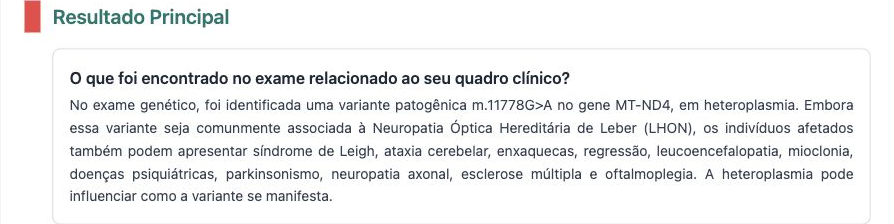
The classification made in NeoVar reaches NeoReport as structured data. The report is written, reviewed and released by a specialist.
Real excerpt from the NeoReport demonstration environment, cut without personal data.
Follow-up after the report
In NeoGenoma and NeoExoma, Infinity Genes reanalyzes negative exomes and genomes every month and cross-checks each new OMIM gene-disease association incorporated by the team against the stored rare variants, with no new sample collection and no extra cost. Findings confirmed by the team are communicated to the requesting physician.
All NeoGenomica tests include Infinity VUS to follow reported variants of uncertain significance. When a relevant reclassification is confirmed after specialist review, the doctor is notified and the report may be updated.
See how the follow-up worksFrequently asked questions
No. Automated features organise evidence and suggest priorities for review. Variant classification, the case conclusion and the release of the report are done by specialists.
Exomes, genomes and sequencing panels performed by NeoGenomica, including somatic oncology panels, are analysed in NeoVar according to the workflow of each test.
Each case records the versions of the databases consulted, such as ClinVar, OMIM, ClinGen, HPO and PanelApp. This way, the classification can be reviewed in light of the evidence available on the date of the analysis.
No. The solved cases page only shows the gene, the variant and, when available, HPO terms, with no name, age, sex, test number or other identifiers.
Yes. Research projects can include variant analysis and prioritisation with NeoVar, according to the approved scope.
Explore the research servicesNext step
Talk to our specialists about the testing strategy and the analysis of your patient’s variants.

